Cloud Microservices & Scalable REST API Architecture
High-performance microservices backend developed for Bangkit Academy capstone (Google, Tokopedia, Gojek & Traveloka), containerized with CI/CD on Google Cloud Run.
1. Context & Problem Statement
The system needed to support both application backend workloads and machine learning inference while remaining scalable, secure, and easy to deploy.
Combining the ML model and backend into a single service would create dependency conflicts, increase deployment complexity, and prevent each workload from scaling independently.
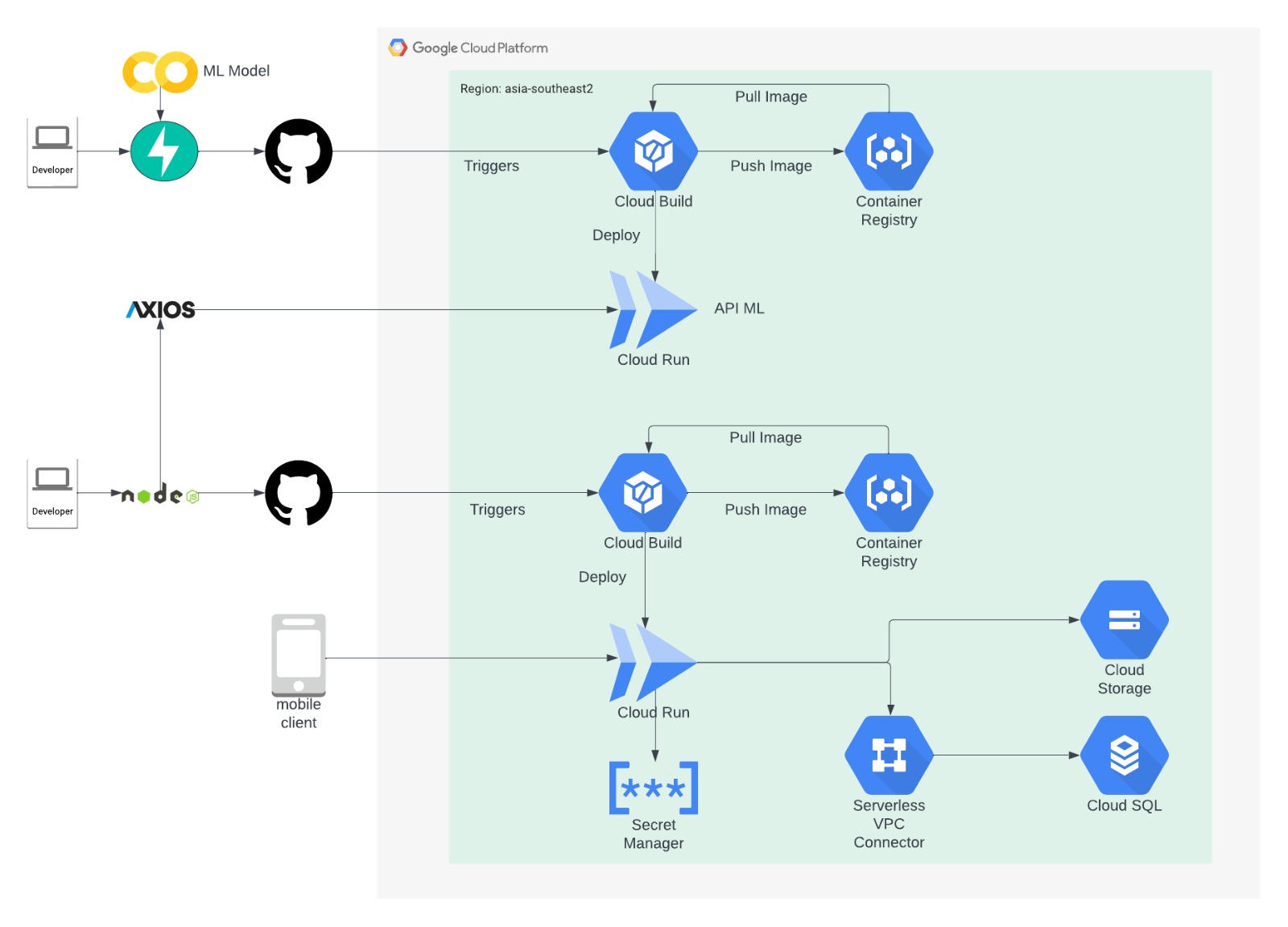
I designed a cloud-native architecture on Google Cloud Platform that separates the ML inference API and Node.js backend into independent Cloud Run services, each with its own CI/CD pipeline. The system integrates Cloud SQL, Cloud Storage, Secret Manager, and Serverless VPC connectivity to support secure and production-ready application workloads.
2. System Architecture & Workflow
                         CLOUD-NATIVE ML SYSTEM

 ┌──────────────────── CI/CD — ML SERVICE ──────────────────────┐

 [ML Engineer]
       │
       ▼
 [Google Colab]
 Model Training
       │
       ▼
    [GitHub]
       │
       ▼
 [Cloud Build]
       │
       ▼
 [Container Registry]
       │
       ▼
 [Cloud Run]
   ML API
       ▲
       │ REST / HTTP
       │
 ──────┼─────────────────────────────────────────────────────────
       │
       │
 [Backend API]
 [Cloud Run]
       │
       ├────────► [ML API]
       │          Model Inference
       │
       ├────────► [Cloud Storage]
       │          Object / File Storage
       │
       ├────────► [Secret Manager]
       │          Credentials / Secrets
       │
       ▼
 [Serverless VPC Connector]
       │
       ▼
    [Cloud SQL]
 Application Database
       ▲
       │
       │ HTTPS / REST
       │
 [Mobile Client]


 ┌────────────── CI/CD — BACKEND SERVICE ───────────────────────┐

 [Backend Developer]
       │
       ▼
    [GitHub]
       │
       ▼
 [Cloud Build]
       │
       ▼
 [Container Registry]
       │
       ▼
 [Cloud Run Backend API]
3. Technical Highlights & Automation
- Independent Service Architecture: Separated the Node.js backend and machine learning inference service into independent Cloud Run deployments, allowing each workload to scale, update, and fail independently.
- Automated CI/CD Pipeline: GitHub pushes automatically trigger Google Cloud Build to build container images, publish them to Container Registry, and deploy new revisions to Cloud Run.
- Containerized Deployment: Packaged both backend and ML services as Docker containers to ensure consistent environments across development and production.
- Serverless Compute: Used Google Cloud Run to provide auto-scaling, managed infrastructure, and on-demand execution without maintaining dedicated application servers.
- Dedicated ML Inference API: Exposed the machine learning model as an independent HTTP API, keeping ML-specific dependencies isolated from the main application backend.
- Secure Secret Management: Stored database credentials, API keys, and environment secrets using Google Cloud Secret Manager instead of embedding sensitive values in source code.
- Private Database Connectivity: Connected Cloud Run to Cloud SQL through a Serverless VPC Connector to provide controlled access to application data.
- Object Storage Integration: Used Google Cloud Storage for application files and assets that should not be stored directly inside the relational database.
- Mobile-to-Cloud API Integration: Designed the backend as the primary API layer for the mobile client while coordinating database, storage, and machine learning inference requests.
- Independent Deployment Lifecycle: Backend changes and ML model changes can be released independently, reducing deployment risk and avoiding unnecessary full-system redeployment.
4. Measurable Results & Impact
4. Measurable Results & Impact
- Reduced application deployment to approximately 3 minutes through automated GitHub → Cloud Build → Cloud Run CI/CD.
- Achieved fully independent deployments for the backend API and ML inference service.
- Eliminated manual container build and server deployment steps through automated cloud-native delivery.
- Enabled automatic workload scaling through Google Cloud Run without provisioning dedicated application servers.
- Improved production security through centralized secret management and private Cloud SQL connectivity.
Engineering Retrospective
Cloud-native architectures require deliberate connection management and container size optimization to succeed under serverless autoscaling.
Related Case Studies
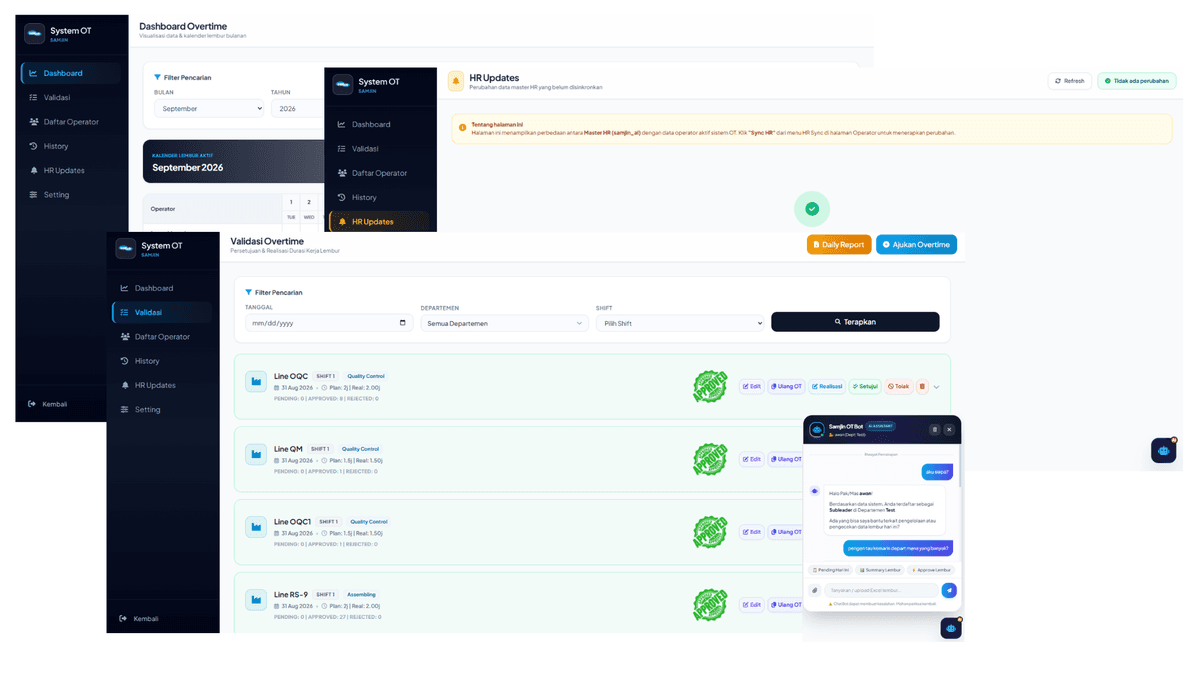
A high-performance on-premise Overtime Management System that automates complex manufacturing shift calculations, real-time validation workflows, and multi-department Excel reports with embedded digital signatures, eliminating manual errors and cutting reporting overhead by 90%.